Is 2 Esdras the same as 4 Ezra?
Yes — different traditions number these books differently. The central Jewish apocalypse (chapters 3–14) is also called '4 Ezra' in scholarly literature. The opening and closing chapters are later Christian additions.
A clear, scholarly introduction to 2 Esdras — also known in scholarly literature as 4 Ezra. The book is a sixteen-chapter Jewish apocalypse composed around AD 90–100 in the aftermath of the destruction of the Jerusalem temple, recording seven visions given to a man named Ezra wrestling with the problem of evil. Its imagery stands deep beneath the Book of Revelation.
Preview the actual file
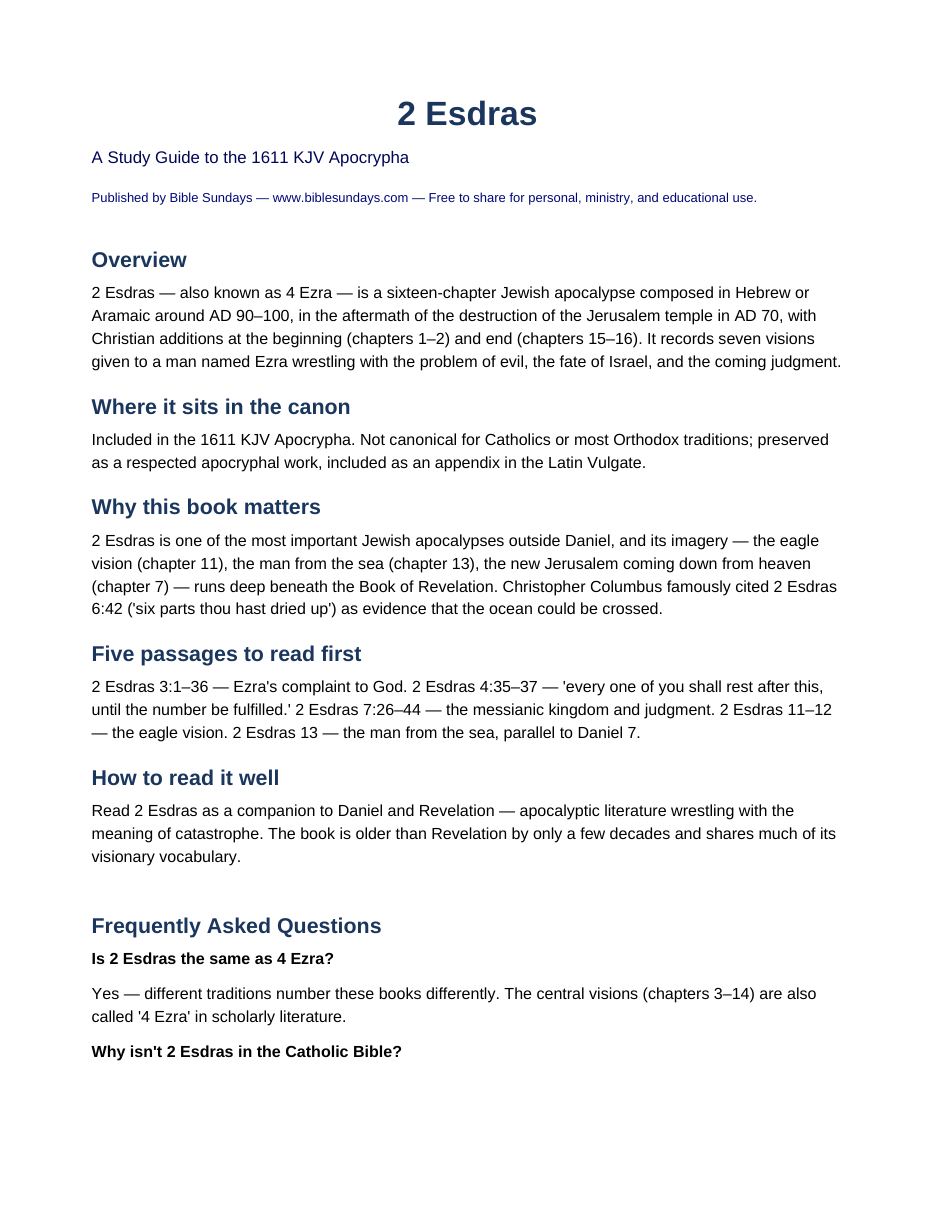
Bible Sundays study guide
2 Esdras — also known in scholarly literature as 4 Ezra — is a sixteen-chapter Jewish apocalypse composed in Hebrew or Aramaic around AD 90–100, in the aftermath of the destruction of the Jerusalem temple in AD 70. The original Jewish work (chapters 3–14) records seven visions given to a man named Ezra wrestling with the problem of evil, the fate of Israel, and the coming judgment. Christian editors later added an opening (chapters 1–2) and closing (chapters 15–16).
2 Esdras was included in the Apocrypha of the original 1611 King James Bible. It is not canonical for Roman Catholics or most Orthodox traditions, though it is preserved as a respected apocryphal work and was included as an appendix in the Latin Vulgate (alongside the Prayer of Manasseh and 3 Esdras / 1 Esdras).
2 Esdras is one of the most important Jewish apocalypses outside Daniel, and its imagery — the eagle vision (chapter 11), the man from the sea (chapter 13), the new Jerusalem coming down from heaven (chapter 7), the souls of the righteous resting until 'the number be fulfilled' (4:35–37) — runs deep beneath the Book of Revelation. Reading it after Revelation is revelatory in the other direction: you discover how thoroughly John was writing within an existing Jewish apocalyptic vocabulary. The book also has a curious historical footnote: Christopher Columbus cited 2 Esdras 6:42 ('six parts thou hast dried up') in his Book of Prophecies as biblical support for his voyage west.
Yes — different traditions number these books differently. The central Jewish apocalypse (chapters 3–14) is also called '4 Ezra' in scholarly literature. The opening and closing chapters are later Christian additions.
Yes — it was included in the Apocrypha of the original 1611 KJV. Most modern KJV editions omit the Apocrypha.
Although deeply respected, it was composed too late to be included in the Hebrew canon and was never received into the Greek Septuagint, so it was not received as canonical at the Council of Trent. It is preserved as an appendix in the Latin Vulgate.
The two books are roughly contemporary and share much of their visionary vocabulary. Direct dependence is debated, but the parallels — the souls under the altar, the new Jerusalem, the messianic kingdom — are striking enough that any serious reader of Revelation benefits from knowing 2 Esdras.
A vision of a great three-headed, twelve-winged eagle rising out of the sea, interpreted as a prophecy of Rome — the fourth beast of Daniel 7 from the Jewish perspective after AD 70.
Yes — Columbus quoted 2 Esdras 6:42 (the proportion of dry land to sea) in his Book of Prophecies as biblical support for his westward voyage. The reference is unmistakable.
The complete 1611 KJV translation of 2 Esdras is included in our free KJV Apocrypha PDF, which contains all fourteen Apocryphal books bound in the original King James Bible.
Yes. This Bible Sundays study guide is free to share for any personal, ministry, or educational purpose.
Continue your study with related content from across our library:
10 curated KJV verses
10 curated KJV verses
In-depth study • Second Coming & Resurrection
In-depth study • The Prepared Heart
End Times
End Times
Every name below appears in the King James Bible. Each page gives the meaning, the verse it appears in, and who carried it in Scripture.
The 14 books included in the original 1611 King James Bible — full text.
View pageTobit, Tobias, Sarah, and the archangel Raphael — 1611 KJV Apocrypha.
View pageThe widow of Bethulia who saved her city — 1611 KJV Apocrypha.
View pageThe Maccabean revolt and the origin of Hanukkah — 1611 KJV Apocrypha.
View pageThe seven brothers and the first clear teaching on bodily resurrection.
View pageThe wisdom book behind James 3 and Matthew 11:28–30.
View pageJeremiah's scribe — confession, Wisdom hymn, Letter of Jeremiah.
View pageAlternative version of Ezra–Nehemiah with 'Great is Truth' speech.
View pageThe most quoted book of the 1611 KJV Apocrypha — free PDF study guide.
View pageThe ancient apocalyptic text quoted in Jude — free download.
View pageThe lost book referenced in Joshua and 2 Samuel — free PDF.
View pageThe second-century-BC 'Little Genesis' retelling — free PDF study guide.
View pageThe 114 sayings from Nag Hammadi — origin, themes, and why it's not in the Bible.
View pageThe earliest Christian church manual (c. AD 50–120) — free PDF.
View pageThe earliest Christian writing outside the New Testament (c. AD 95).
View pageEarly Christian tract bound into Codex Sinaiticus — Two Ways teaching.
View pageSecond-century Roman apocalypse — Visions, Mandates, and Similitudes.
View pageThe Dead Sea Scrolls text about the Nephilim sons of the Watchers.
View pageEnoch's journey through the seven heavens and the birth of Melchizedek.
View pageThe heavenly palaces and Enoch transformed into the angel Metatron.
View pageThe first couple after Eden — Satan's second temptation and the Cave of Treasures.
View pageThe fragmentary Coptic text — what survives and why it isn't in the Bible.
View pageThe Gnostic text from Codex Tchacos and why the church rejected it.
View pageWhat was found at Qumran and what the scrolls prove about the Bible.
View pageThe fifteen-verse penitential prayer of Judah's most wicked king — 1611 KJV Apocrypha.
View pageThe falsely accused wife, the two elders, and Daniel's cross-examination.
View pageDaniel exposes the priests of Bel, kills the dragon, and survives a second lions' den.
View pageThe six Greek additions that give Esther her prayer and finally name God.
View pageThe Epistle of Jeremy — seventy-two verses against the idols of Babylon.
View pageThe Prayer of Azariah and the Benedicite, sung inside the fiery furnace.
View pageThe Akhmim fragment, the talking cross, and why the church rejected it by AD 200.
View pageThe Infancy Gospel that gave us Joachim, Anna, and the cave of the nativity.
View pageThe Nag Hammadi text behind the Mary Magdalene 'companion' claim — read honestly.
View pageSeven letters written in chains around AD 107, on the road to the arena.
View pageHis letter to the Philippians and the earliest Christian martyr account.
View pageThe second-century apology on Christians as sojourners and the 'sweet exchange'.
View pagethe Acts of Pilate, the trial narrative, and the Harrowing of Hell
View pagethe clay sparrows, the cursed playmate, and the boy Jesus in the temple
View pagethe second-century vision of heaven and hell that shaped Dante
View pagethe deathbed speeches of Jacob's sons, their moral teaching, and their Qumran background
View pagethe second-century story of the convert of Iconium, the arena at Antioch, and the physical description of Paul
View pagethe 1945 discovery, the 52 Coptic texts, what Gnosticism taught, and why these gospels are not in the Bible
View pageThe complete 66-book King James Version — free download.
View pageThe original Authorized Version — free PDF of the historic 1611 KJV.
View pageFull library — KJV, Apocrypha, Old & New Testament downloads.
View page