Is the Book of Tobit in the King James Bible?
Yes — it was included in the Apocrypha of the original 1611 KJV, between Nehemiah and Judith. Most modern KJV editions omit the Apocrypha, but full 1611-style editions still contain it.
A clear, scholarly introduction to the Book of Tobit — the fourteen-chapter exile narrative about Tobit, his son Tobias, the woman Sarah, and the archangel Raphael disguised as a travelling companion. Tobit was included in the Apocrypha of the original 1611 King James Bible and is canonical for Catholics and Eastern Orthodox. This free guide walks through its plot, theology, and best-known passages.
Preview the actual file
Bible Sundays study guide
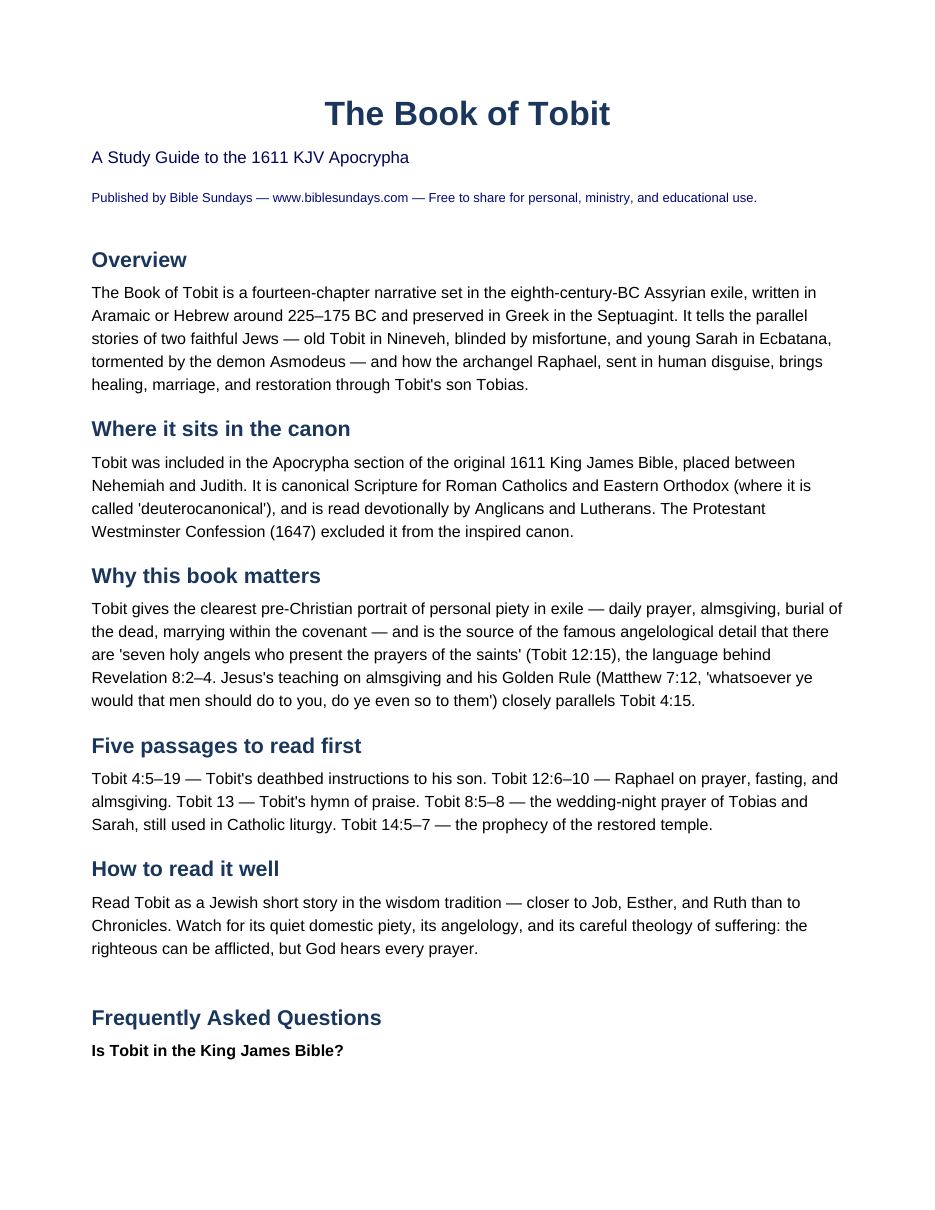
Tobit is a fourteen-chapter narrative set in the eighth-century-BC Assyrian exile, written in Aramaic or Hebrew around 225–175 BC and preserved in Greek in the Septuagint. It tells the parallel stories of two faithful Jews — old Tobit in Nineveh, blinded by misfortune, and young Sarah in Ecbatana, tormented by the demon Asmodeus who has killed her seven previous bridegrooms — and how the archangel Raphael, sent in human disguise as the travelling companion Azarias, brings healing, marriage, and restoration through Tobit's son Tobias.
Tobit was included in the Apocrypha section of the original 1611 King James Bible, placed between Nehemiah and Judith. It is canonical Scripture for Roman Catholics (who call it 'deuterocanonical') and Eastern Orthodox, and is read devotionally by Anglicans and Lutherans. The Protestant Westminster Confession (1647) excluded it from the inspired canon while still permitting its devotional use.
Tobit gives the clearest pre-Christian portrait of personal piety in exile — daily prayer, almsgiving, burial of the dead, marrying within the covenant — and is the source of the famous detail that there are 'seven holy angels which present the prayers of the saints' (Tobit 12:15), the language behind Revelation 8:2–4. Jesus's own teaching on almsgiving (Matthew 6:1–4) and his version of the Golden Rule ('whatsoever ye would that men should do to you, do ye even so to them,' Matthew 7:12) closely parallels Tobit 4:15. Reading Tobit helps modern Christians hear the New Testament writers as their first audience would have.
Yes — it was included in the Apocrypha of the original 1611 KJV, between Nehemiah and Judith. Most modern KJV editions omit the Apocrypha, but full 1611-style editions still contain it.
Most scholars read Tobit as edifying religious fiction set against a real historical backdrop, not as straight history. It belongs to the same Jewish short-story genre as Esther, Ruth, and Judith.
Asmodeus is a demon named in Tobit 3:8 who kills Sarah's first seven husbands on their wedding night. The name reappears in later Jewish tradition (Talmud) but not in the rest of the biblical canon.
Raphael is one of 'the seven holy angels which present the prayers of the saints' (Tobit 12:15). He is sent by God in human form as Azarias to accompany young Tobias, heal Tobit's blindness, and free Sarah from Asmodeus.
Most scholars date the composition to roughly 225–175 BC, in either Aramaic or Hebrew. The book is set centuries earlier, in the eighth-century-BC Assyrian exile.
The Reformers followed Jerome in distinguishing the Hebrew Old Testament from the Greek-only books, which they classed as Apocrypha — useful but not inspired Scripture.
The complete 1611 KJV translation of Tobit is included in our free KJV Apocrypha PDF, which contains all fourteen Apocryphal books bound in the original King James Bible.
Yes. This Bible Sundays study guide is free to share for any personal, ministry, or educational purpose.
Continue your study with related content from across our library:
A journey through the miracles of Elisha and the history of the divided kingdoms
History & Origins
A study of the laws, sacrifices, and holiness of Israel in the book of Leviticus
10 curated KJV verses
In-depth study • Bible Study
In-depth study • Scripture Study
Every name below appears in the King James Bible. Each page gives the meaning, the verse it appears in, and who carried it in Scripture.
The 14 books included in the original 1611 King James Bible — full text.
View pageThe widow of Bethulia who saved her city — 1611 KJV Apocrypha.
View pageThe Maccabean revolt and the origin of Hanukkah — 1611 KJV Apocrypha.
View pageThe seven brothers and the first clear teaching on bodily resurrection.
View pageThe wisdom book behind James 3 and Matthew 11:28–30.
View pageJeremiah's scribe — confession, Wisdom hymn, Letter of Jeremiah.
View pageAlternative version of Ezra–Nehemiah with 'Great is Truth' speech.
View pageJewish apocalypse with imagery behind the Book of Revelation.
View pageThe most quoted book of the 1611 KJV Apocrypha — free PDF study guide.
View pageThe ancient apocalyptic text quoted in Jude — free download.
View pageThe lost book referenced in Joshua and 2 Samuel — free PDF.
View pageThe second-century-BC 'Little Genesis' retelling — free PDF study guide.
View pageThe 114 sayings from Nag Hammadi — origin, themes, and why it's not in the Bible.
View pageThe earliest Christian church manual (c. AD 50–120) — free PDF.
View pageThe earliest Christian writing outside the New Testament (c. AD 95).
View pageEarly Christian tract bound into Codex Sinaiticus — Two Ways teaching.
View pageSecond-century Roman apocalypse — Visions, Mandates, and Similitudes.
View pageThe Dead Sea Scrolls text about the Nephilim sons of the Watchers.
View pageEnoch's journey through the seven heavens and the birth of Melchizedek.
View pageThe heavenly palaces and Enoch transformed into the angel Metatron.
View pageThe first couple after Eden — Satan's second temptation and the Cave of Treasures.
View pageThe fragmentary Coptic text — what survives and why it isn't in the Bible.
View pageThe Gnostic text from Codex Tchacos and why the church rejected it.
View pageWhat was found at Qumran and what the scrolls prove about the Bible.
View pageThe fifteen-verse penitential prayer of Judah's most wicked king — 1611 KJV Apocrypha.
View pageThe falsely accused wife, the two elders, and Daniel's cross-examination.
View pageDaniel exposes the priests of Bel, kills the dragon, and survives a second lions' den.
View pageThe six Greek additions that give Esther her prayer and finally name God.
View pageThe Epistle of Jeremy — seventy-two verses against the idols of Babylon.
View pageThe Prayer of Azariah and the Benedicite, sung inside the fiery furnace.
View pageThe Akhmim fragment, the talking cross, and why the church rejected it by AD 200.
View pageThe Infancy Gospel that gave us Joachim, Anna, and the cave of the nativity.
View pageThe Nag Hammadi text behind the Mary Magdalene 'companion' claim — read honestly.
View pageSeven letters written in chains around AD 107, on the road to the arena.
View pageHis letter to the Philippians and the earliest Christian martyr account.
View pageThe second-century apology on Christians as sojourners and the 'sweet exchange'.
View pagethe Acts of Pilate, the trial narrative, and the Harrowing of Hell
View pagethe clay sparrows, the cursed playmate, and the boy Jesus in the temple
View pagethe second-century vision of heaven and hell that shaped Dante
View pagethe deathbed speeches of Jacob's sons, their moral teaching, and their Qumran background
View pagethe second-century story of the convert of Iconium, the arena at Antioch, and the physical description of Paul
View pagethe 1945 discovery, the 52 Coptic texts, what Gnosticism taught, and why these gospels are not in the Bible
View pageThe complete 66-book King James Version — free download.
View pageThe original Authorized Version — free PDF of the historic 1611 KJV.
View pageFull library — KJV, Apocrypha, Old & New Testament downloads.
View page